Thursday, February 2, 2017

Snap files for its IPO, revealing surging sales growth and huge losses Snap files for its IPO, revealing surging sales growth and huge losses

Evan Spiegel Snapchat Co-Founder and CEO Evan Spiegel. Kimberly White/Getty Images for Vanity Fair

Snapchat's parent company Snap Inc. set in motion what could be the biggest tech flotation in years by revealing it generates over $400 million in annual sales and has 158 million people using its app on a daily basis.

The Los Angeles-based company released the financial details in its filing for an initial public offering on Thursday.

  • The company filed for a $3 billion IPO, though that is a placeholder amount and certain to change as the company sets a price on the deal.
  • In the filing, Snap disclosed that Snapchat has 158 million average daily active users as of the fourth quarter of 2016.
  • It had annual revenue of $404.4 million in 2016, up from $58.6 million in 2015.
  • The IPO filing shows Morgan Stanley, Goldman Sachs, JPMorgan, Deutsche Bank, Barclays, Credit Suisse, and Allen & Company are among the banks working on the share sale.
  • It plans to list its shares on the New York Stock Exchange under the ticker SNAP.

Now that its financial statements are public, the company must wait 15 days before holding formal meetings, aka the IPO "roadshow," with investors. Snap is planning to list shares in March, and could fetch a valuation of as much as $25 billion, people familiar with the matter have said. Screen Shot 2017 02 02 at 4.45.54 PMSnapchat's quarterly average daily active users in millions.Snap Inc. IPO filing

The company's 26-year-old CEO, Evan Spiegel, will be the focus of the message that management conveys to investors in those meetings, people familiar with Snap's roadshow planning have said. He will be framed as a visionary, similar to how Facebook CEO Mark Zuckerberg was depicted before that company's flotation.

Spiegel owns 21.8% of the company's class A shares, the filing shows, making him the largest shareholder along with cofounder Robert Murphy who owns the same number of shares. They also own class B and class C shares.

That Snap would go public has been a foregone conclusion on Wall Street and in Silicon Valley for months. The company last year added a seasoned IPO specialist to its board and then changed its name from Snapchat to Snap in a move that it said was meant to speak to public investors.

"You can search Snapchat or Spectacles for the fun stuff and leave Snap Inc. for the Wall Street crowd :)" the company said in a blog post in September.

Snap's business is quickly evolving from the chat app that gave it its name. It has increased advertising and added news, and last year it began selling its Spectacles, eyeglasses that can take photos and record video.

Still, as Snap begins to meet with investors, it will need to explain what its total addressable market can be — outside of the millennial demographic it's already popular with. It will also have to lay out a vision for how revenue can grow from less than $1 billion to many billions.

The company did report meteoric growth in sales, which comes from advertising on the platform. Annual revenue of $404 million is up from just $58.6 million in 2015, the filings show. It grew daily active users by almost 50% in the past year.

Still, its losses are also growing — to $514 million in 2016, from almost $373 million a year earlier. And the angle Snap chooses in pitching itself to Wall Street will be important. The company's recent foray into hardware and its new identity as a "camera company" could cause investors to value it differently than a pure-play internet company, where profit margins are typically higher.

"We believe that reinventing the camera represents our greatest opportunity to improve the way that people live and communicate," the filing reads. "Our products empower people to express themselves, live in the moment, learn about the world, and have fun together."

Snap said it plans to use the IPO proceeds for "general corporate purposes" and that it may use a portion for acquisitions. It doesn't have any deals in place right now.

Alex Heath contributed reporting.
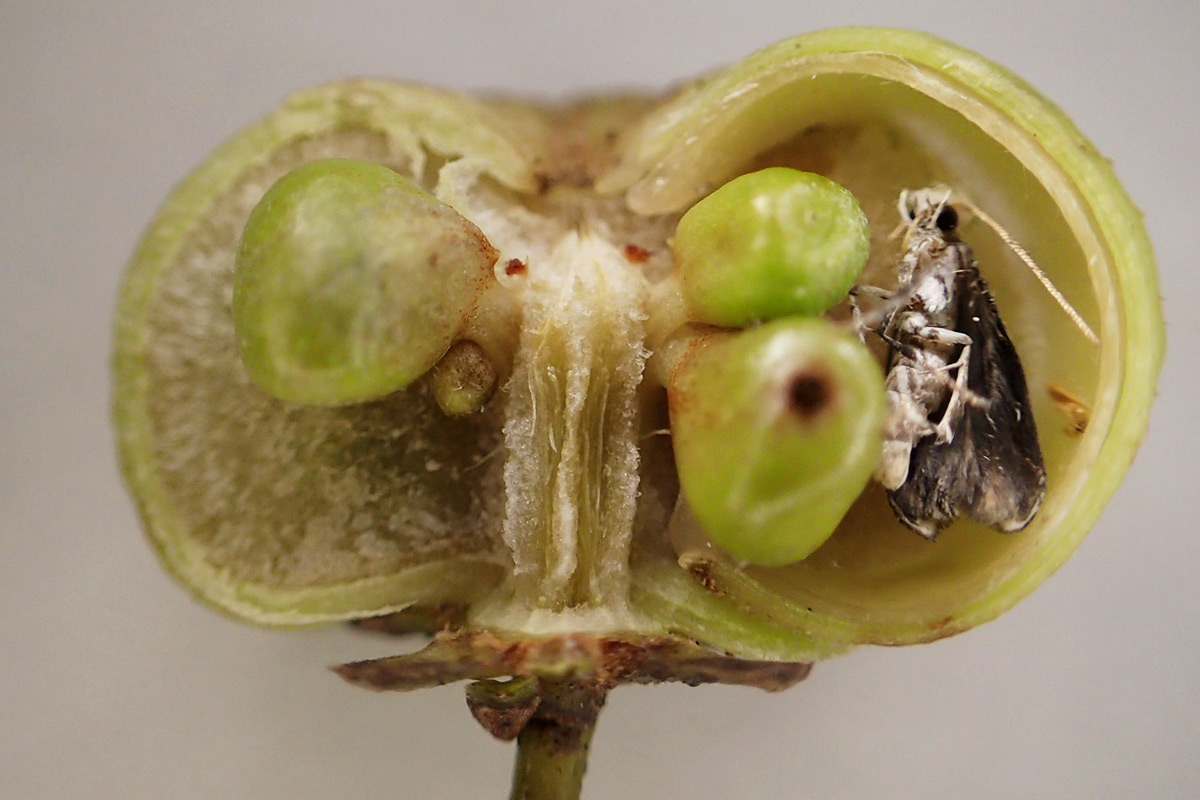
Plant keeps moths captive inside its fruits for almost a year

Fruit sliced in half to reveal moth
Fruitful relationship

Shi-Xiao Luo, et al.

By Colin Barras

Species: Leafflower moths, specifically Epicephala lanceolaria
Habitat: Forests of East Asia

Visit a forest in south-east China, say, in mid-March and you might catch one of the more unusual sights in the natural world. The ripe fruit of one species of tree burst open at that time each year – and fully developed moths fly out.

Leafflower moths have a special relationship with leafflower trees, of the genus Glochidion. The trees produce male and female flowers in April and May. Most insects overlook them by day, perhaps because they don’t produce nectar.

At night, though, the flowers release a perfume that is irresistible to leafflower moths. Females flock to the trees and perform a very specific routine. First, they visit the male flowers, where they carefully collect pollen on their proboscis. Then they head to a female flower, using the pollen to fertilise the bloom. Pollination complete, they lay one egg in the flower.

A few months later, the egg hatches. By that time, the fertilised flower should have matured into a fruit, providing the larva with food – it eats two or three of the half-dozen seeds inside.

Under the surface: Cushion plants harbour tiny mountain worlds inside

Eventually the intimate relationship with the trees ends when the larva chews its way out of the fruit, pupates on the forest floor over winter and emerges as an adult moth in the spring.

One species – E. lanceolaria – does things a little differently. It still lays its eggs in April and May, but the species of tree it chooses – G. lanceolarium – takes ages to bear fruit. In fact, it isn’t until January of the following year that the fruit begin to develop. Only at this point do the larvae emerge from their eggs and begin to feed on the fruit.

With their development squeezed into a few short months, the larvae simply metamorphose into adults while still inside the fruit. A few weeks later, in March, the fruits mature – and the moths fly out, just in time to mate and lay their eggs in the tree’s new blooms.

“The moth turns to an adult in the fruit, and then flies out when the mature fruit opens on the branches,” says Shi-Xiao Luo at the Chinese Academy of Sciences in Guangzhou. He says the behaviour is unique among leafflower moths.

Atsushi Kawakita at Kyoto University, Japan, agrees. He was a member of the team that discovered the relationship between leafflower trees and leafflower moths in 2003. “I know of no other example where a [butterfly or moth] matures as a winged adult literally inside the host plant tissue,” he says.

Unusually intimate

The fact that they do means this relationship between plant and moth is unusually intimate – which might be of particular benefit to the G. lanceolarium tree.

“The host plant has the ultimate control of when the moths will be in flight. This [seems to] coincide with the next flowering period of the host plant,” says Kawakita. “So the findings point to the possibility that the plants are ‘hoarding’ their mutualist partners until the plants themselves are ready for the next reproduction event.”

The relationship is the “next step forward in terms of intimacy”, he says.

Read more: Armoured wasps chop off opponents’ heads in brutal fig wars

Biologists are still trying to understand how this sort of mutualistic relationship arises. One idea is that it appears gradually as a result of a long period of co-evolution involving the two lineages. This does seem to be the case for leafflower trees and moths in general. The evolutionary histories of the two groups match each other almost perfectly.

But E. lanceolaria doesn’t fit. It lies at the very base of the leafflower moth “evolutionary tree”, but the species of leafflower tree it partners with isn’t similarly basal – it is one of the more recent species of leafflower tree to evolve. In other words, E. lanceolaria and G. lanceolarium don’t seem to have co-evolved over a long period in the same way that other leafflower trees and moths have.

Luo and his colleagues think the moth might have begun laying eggs in G. lanceolarium trees relatively recently, perhaps displacing another species of leafflower moth in the process. “Highly intimate and coevolved associations may be more evolutionarily dynamic than had been previously realised,” he says.

It’s a view shared by Guillaume Chomicki at the University of Munich in Germany, who studies the evolutionary dynamics of mutualism. He agrees that the new findings suggest intimate mutualism is not just about the gradual co-diversification of two evolutionary lineages.

“It’s a major leap forward,” he says. “We know so little about the evolution and stability of mutualism over geological time.”

Journal reference: The American Naturalist, DOI: 10.1086/690623

D’Arcy Wentworth Thompson, the man who shaped biology and art

Filigree-like artwork called Aggregation 24 by Andy Lomas

Andy Lomas, Aggregation 24, 2005, Uni of Dundee, Art Fund and Esmée Fairbairn Foundation

By Simon Ings

In a small, windowless corner of the University of Dundee, UK, Caroline Erolin of the Centre for Anatomy & Human Identification is ironing a fossilised pterodactyl.

At least, that’s what she appears to be doing. In fact, Erolin’s “iron” is a handheld 3D scanner, and her digitised animals are now being used as teaching aids worldwide. Her enthusiasm for the work (which she has to squeeze between research into medical visualisation and haptics) is palpable. She is not just bringing animals back from the dead, but helping to bring a great collection back to life.

Advertisement

In 1884, the biologist and classicist D’Arcy Wentworth Thompson began assembling a teaching and research museum in Dundee. An energetic philanthropist and a natural diplomat, Thompson had a broad network of friends and contacts – among them members of Dundee’s own whaling community, who provided him with extraordinary, then-unique specimens of Arctic fauna.

In 1956, the building that housed the University of Dundee’s natural history department was scheduled for demolition and Thompson’s collection, created as part of his work there, was dispersed. Scholars have been scrambling to recover its treasures ever since. Asked whether it can in fact be reassembled, Erolin laughs and gestures at the confines in which the surviving items are (rather artfully) squeezed. “It’s a question of space. We’re already sitting on an entire elephant skeleton. Where on earth would we put that?”

It’s largely not a genuine problem though, in part because advances in digitisation are changing the priorities of collections worldwide. Even more importantly, it is generally acknowledged that Thompson has outgrown Dundee: he belongs to the world. Together with Charles Darwin, Thompson, who died in 1948, is the most culturally influential English-speaking biologist in history.

We have one book to thank for that: On Growth and Form, first published in 1917 – an event commemorated by an exhibition, A Sketch of the Universe: Art, science and the influence of D’Arcy Thompson, at the Edinburgh City Art Centre.

“Thompson described his landmark book as all preface”

Neither in the first edition nor in the revised and expanded 1942 version does Thompson talk much about Darwin, and even in the 1940s he considered genetics hardly more than a distraction. Thompson was pursuing an entirely different line: the way in which physical constraints and the initial conditions of __life shape the development of plants and animals.

Thompson was fascinated by tiny, single-celled shelled organisms such as foraminifera and radiolaria. He was convinced (rightly) that their wildly diverse shell shapes play no evolutionary role: they arise at random, their beauty emerging from the self-organising properties of matter, not from any biological code.

Even as geneticists like Ernst Mayr and Theodosius Dobzhansky were revealing the genetic mechanisms that constrain how living things evolve, Thompson was revealing the constraints and opportunities afforded to living things by physics and chemistry. Crudely put, genetics explains why all dogs, say, look like dogs. Thompson did something different: he glimpsed why dogs look the way they do.

Most of Thompson’s contemporaries were caught up in a genetic revolution, synthesising the seemingly incompatible demands of chromosomal genetics and Darwinian selection theory. No one ever seriously doubted Thompson’s importance – his book has always been a classic text – but at the same time, few have ever quite known what to do with him.

Portrait of D

Darren McFarlane, Scarus, Pomacanthus, 2012, oil on canvas. (University of Dundee Museum Services © the artist)

Thompson himself (pictured above as morphed by artist Darren McFarlane) understood the problem; he described his landmark book as “all preface”: the sketch of a territory he lacked the mathematical skill to penetrate. What the arguments in On Growth and Form really needed is a computer, and a big one at that (which makes Thompson a character who might have dropped straight out of the pages of Tom Stoppard’s play Arcadia).

Artists, on the other hand, from Henry Moore to Richard Hamilton to Eduardo Paolozzi, knew exactly what to do – and the Edinburgh exhibition combines the University of Dundee’s own collection of biomorphic, Thompsonesque art with new commissions. Several stand-out pieces are by artists who were students at Dundee’s own Duncan of Jordanstone College of Art and Design.

To its credit, Thompson’s alma mater has not been slow to exploit the way his meticulous and beautiful work straddles art and science: it supports a dedicated art-science crossover gallery called LifeSpace, as well as offering degrees in animation, medical art and medical imaging, connecting digital processes with traditional illustration. They are making the most of On Growth and Form‘s centenary, but the influence of Thompson on the university is deep and abiding.

That is as well. For all our anxious predictions about genetic engineering, for all the hype surrounding synthetic biology, and all the many hundreds of graduate design shows stuffed with “imaginary animals”, we have barely begun to explore let alone exploit the spaces Thompson’s vision revealed to us.

A Sketch of the Universe is on show at the City Art Centre, Edinburgh, UK, from now to 19 February

Visit the official On Growth and Form centenary website for details of more events throughout the year

'NO FEDERAL FUNDS?': Trump threatens UC Berkeley after campus erupts in protests over Milo Yiannopoulos speech 'NO FEDERAL FUNDS?': Trump threatens UC Berkeley after campus erupts in protests over Milo Yiannopoulos speech

Donald Trump President Donald Trump at a ceremony at the White House on Wednesday for the swearing-in ceremony of Rex Tillerson as secretary of state. AP Photo/Carolyn Kaster

President Donald Trump on Thursday threatened to pull federal funding from the University of California at Berkeley after the campus experienced violent protests over a planned speech from conservative provocateur Milo Yiannopoulos.

"If U.C. Berkeley does not allow free speech and practices violence on innocent people with a different point of view - NO FEDERAL FUNDS?" Trump wrote on Twitter on Thursday morning.

Berkeley is the flagship campus of the public University of California system. UC Berkeley received $370 million in federal research funding in 2015-2016, according to the university's website.

Yiannopoulos, an editor at the far-right website Breitbart News whom many identify with the alt-right, a white-nationalist movement, was set to appear as part of a book tour.

The event was canceled after demonstrators threw smoke bombs and flares, The Associated Press and local media reported.

UC Berkeley, notably, is considered the home of the Free Speech Movement of the 1960s.

UC Berkeley Milo Yiannopoulos protests Protesters watching a bonfire Wednesday night on Sproul Plaza during a rally against the scheduled speaking appearance by Breitbart News editor Milo Yiannopoulos on the University of California at Berkeley campus. AP Photo/Ben Margot

UC Berkeley issued this statement on the protests:

"Amid violence, destruction of property and out of concern for public safety, the University of California Police Department determined that it was necessary to remove Milo Yiannopoulos from the campus and to cancel tonight's scheduled 8 p.m. performance.

"The decision was made at about 6 p.m., two hours before the event, and officers read several dispersal announcements to the crowd of more than 1,500 protesters that had gathered outside of the Martin Luther King, Jr. ASUC venue.

"We condemn in the strongest possible terms the violence and unlawful behavior that was on display and deeply regret that those tactics will now overshadow the efforts to engage in legitimate and lawful protest against the performer’s presence and perspectives."

Bryan Logan contributed reporting to this story.

Editor's note: Milo Yiannopoulos has previously authored columns published by Business Insider.

Wednesday, February 1, 2017

Chimps beat up, murder and then cannibalise their former tyrant

Chimp with Foudouko
A violent end

Jill D. Pruetz

By Chelsea Whyte

It was a gruesome scene. The body had severe wounds and was still bleeding despite having been lying for a few hours in the hot Senegalese savanna.

The murder victim, a West African chimpanzee called Foudouko, had been beaten with rocks and sticks, stomped on and then cannibalised by his own community.

This is one of just nine known cases where a group of chimpanzees has killed one of their own adult males, as opposed to killing a member of a neighbouring tribe.

Advertisement

Read more: Gang of chimpanzees kills their alpha male

These intragroup killings are rare, but Michael Wilson at the University of Minnesota says they are a valuable insight into chimp behaviour such as male coalition building.

“Why do these coalitions sometimes succeed, but not very often? It’s at the heart of this tension between conflict and cooperation, which is central to the lives of chimpanzees and even to our own,” he says.

Chimps usually live in groups with more adult females than males, but in the group with the murder it was the other way round.

“When you reverse that and have almost two males per every female — that really intensifies the competition for reproduction. That seems to be a key factor here,” says Wilson.

Jill Pruetz at Iowa State University, who has been studying this group of chimpanzees in south-eastern Senegal since 2001, agrees. She suggests that human influence may have caused this skewed gender ratio that is likely to have been behind this attack. In Senegal, female chimpanzees are poached to provide infants for the pet trade.

Fall from power

Thirteen years ago, Foudouko reigned over one of the chimp clans at the Fongoli study site, part of the Fongoli Savanna Chimpanzee Project. As alpha male, he was “somewhat of a tyrant”, Pruetz says.

Foudouko gained alpha status in his late teens and ruled alongside his right-hand chimp, Mamadou, the group’s beta male. In 2007, Mamadou was severely injured and separated from the group for weeks, returning frail and holding a lower rank in the social hierarchy.

Because Foudouko maintained an alliance with his now-weak partner, he was ostracised and then ousted by the others. He lived alone on the outskirts of chimp society for years, only being observed by researchers in the field once or twice a year.

Chimpanzee groups at Fongoli are fairly isolated, so Foudouko’s only chance of finding a mate was to rejoin the group. By 2013, Mamadou had regained beta male status and his brother, David, had taken over as alpha. They accepted Foudouko back into the fold, although other members of the group still chased him off periodically.

“We just happened to have at the time five young males all coming up in the hierarchy and those guys together didn’t want to let Foudouko back in,” says Pruetz. “He was trying to come back in at a high rank, which was ultimately a foolish thing to do on his part.”

Going ape

Early one morning, Pruetz and her team heard loud screams and hoots from the chimps’ nearby sleep nest. At dawn, they found Foudouko dead, bleeding profusely from a bite to his right foot. He also had a large gash in his back and a ripped anus. Later he was found to have cracked ribs. Pruetz says Foudouko probably died of internal injuries or bled out from his foot wound.

Foudouko also had wounds on his fingers. These were likely to have been caused by chimps clamping them in their teeth to stretch his arms out and hold him down during the attack, says Pruetz.

After his death, the gang continued to abuse Foudouko’s body, throwing rocks and poking it with sticks, breaking its limbs, biting it and eventually eating some of the flesh.

“It was striking. The female that cannibalised the body the most, she’s the mother of the top two high-ranking males. Her sons were the only ones that really didn’t attack the body aggressively,” Pruetz says, adding that Mamadou even tried to wake his old partner.

Read more: Monkey seen caring for dying mate then grieving after she dies

“Do chimpanzees understand death? It’s not clear if they do,” says Wilson, who studies chimpanzees in East Africa. “It seems unlikely that they know about using pulse or breath to make sure something’s dead, so we do see them beating on individuals they’ve killed after they’ve expired. But the cannibalisation was unusual.”

Pruetz says since Foudouko’s death, Mamadou has been kicked out of the group by the same young males who attacked his past ally.

“The way the chimps behave is the way they used to act with Foudouko [when he was trying to re-enter the group]. The saga continues,” she says.

Journal reference: International Journal of Primatology, DOI: 10.1007/s10764-016-9942-9

Read more: First case of lethal female aggression seen in orangutans

Pom-pom crabs prune their living decorations like bonsai trees

By Chelsea Whyte

Zoologger is our weekly column highlighting extraordinary animals – and occasionally other organisms – from around the world.

Species: Lybia leptochelis (adorned by Alicia)
Habitat: under loose rocks between the coral reefs in the shallow tidal zones of the Red Sea

Keep your friends close but your anemones closer. Boxer crabs have this lesson down pat.

In each claw, these miniscule crabs hold even smaller anemones. It’s these accessories that give the crustaceans their other popular name – pom-pom crabs.

At just a few millimetres wide and heavily camouflaged to mimic fuzzy algae, these itty-bitty crabs are tricky to find in the shallow waters of tidal zones on the Red Sea.

“The crabs are quite camouflaged in their environment, but their anemones are what stick out,” says  Yisrael Schnytzer, a marine biologist now at the Marine Biological Laboratory in Woods Hole, Massachusetts. “When you turn over a rock, you don’t see the crab, but you see these two little flashlights that are the anemones.”

He placed pairs of crabs in aquariums, one holding anemones and one without, and found that they fight and steal one another’s anemones. “No one is ever hurt in these fights as far as we can tell,” he says.

In most cases, the crab that started without anemones comes away with one, and in about half the cases it’s actually the crab holding anemones that started the sparring.

“That’s strange,” Schnytzer says. “You’ve got some valuable resource you may be giving away. That leads us to think there’s something ritualistic here. Maybe they have to fight even if they don’t want to.”

When they’re born, boxer crabs don’t have anemones. They don’t even have claws. They float around in their larval stage as they develop, but when they end up on the sea floor they acquire the anemones soon after they land, Schnytzer says.

Pruning the pom-poms

They have delicate claws that they rarely use for anything but holding onto their anemones. Their claws have a series of small hooks that once embedded in the anemones keep them from getting away.

The crabs tend the anemones a bit like a bonsai tree, limiting their food and even sometimes nibbling at them to keep them small enough to hold easily.

“It’s controlling the fate of the anemone,” says Antonio Baeza, an evolutionary biologist at Clemson University. “Maybe the anemone has no say here and it’s totally at the mercy of the crab.”

Baeza says this is not your typical anemone-crab relationship. In most other partnerships between crustaceans and anemones, a large anemone acts as a host for the crab and they both benefit in obvious ways.

“For the anemone, transportation could be beneficial,” Baeza says. “A more important benefit for the anemone here is maybe profiting from the leftovers of the crabs while eating. Crabs are messy eaters.”

The only time they let them go is while grooming in private moments, but Schnytzer and his team caught these unguarded moments by building the crabs shelters in their lab aquaria that allowed them to peek in.

“They’d let go of one of their anemones and hold it with one of their feet, and with the vacant claw clean their antennae and face. This is common grooming behavior known in other crabs. They’d only do this hiding away in secrecy,” he says.

Split the difference

When a pom-pom crab loses an anemone in head-to-head battle, they simply grab the remaining anemone and stretch it apart, tearing it into two equal parts. The remaining pieces regenerate back to a size similar to the original.

This forced asexual reproduction may offer some benefit to the anemones – the crabs do help them multiply after all – but it results in lower diversity for the anemone population.

“One of the benefits of asexual reproduction, even if it’s forced, is that you have clones of the same genome in the environment. That’s a good way to propagate your genome in an environment that doesn’t change too much,” says Baeza.

“Every single crab we’ve ever found was found holding an anemone, but we’ve never found a free-living anemone,” Schnytzer says. “We started making these crazy theories, like maybe there’s a secret anemone garden.”

The coast where we these crabs live is an area of no more than a few square kilometres and there are dozens of researchers out there, he says, and no one has reported seeing any lone anemones like these.

“The anemones are being carried around, and the very fact that we haven’t found them, we have to say maybe they are dependent on the crabs,” Schnytzer says.

Journal reference: PeerJ, DOI: 10.7717/peerj.2954


Article amended on 31 January 2017

When this article was first published, it misstated the institution to which Yisrael Schnytzer is affiliated.

There are major differences between Trump's immigration ban and Obama's 2011 policy There are major differences between Trump's immigration ban and Obama's 2011 policy

donald trump executive order extreme vettingUS President Donald Trump signing an executive order in front of Vice President Mike Pence, left, and Defense Secretary James Mattis.Reuters/Carlos Barria

In a statement on Sunday, President Donald Trump defended his executive order temporarily barring nationals from seven majority-Muslim countries by invoking a policy set by former President Barack Obama in 2011.

"My policy is similar to what President Obama did in 2011 when he banned visas for refugees from Iraq for six months," the statement said. "The seven countries named in the Executive Order are the same countries previously identified by the Obama administration as sources of terror."

But lawyers and former Obama administration officials have since criticized the comparison, arguing that the 2011 immigration restrictions, during which Obama administration slowed its processing of Iraqi refugee applications, was fundamentally different in intent and logistics. Politifact rated the comparison "mostly false," saying Trump's ban was much broader than the previous administration's and did not respond to a specific threat.

The Obama administration instituted the policy following the discovery that two men suspected of making bombs to target American troops in Iraq were living in Kentucky as refugees, ABC News reported in 2013.

Here's how the two policies compare:

View As: One Page Slides